
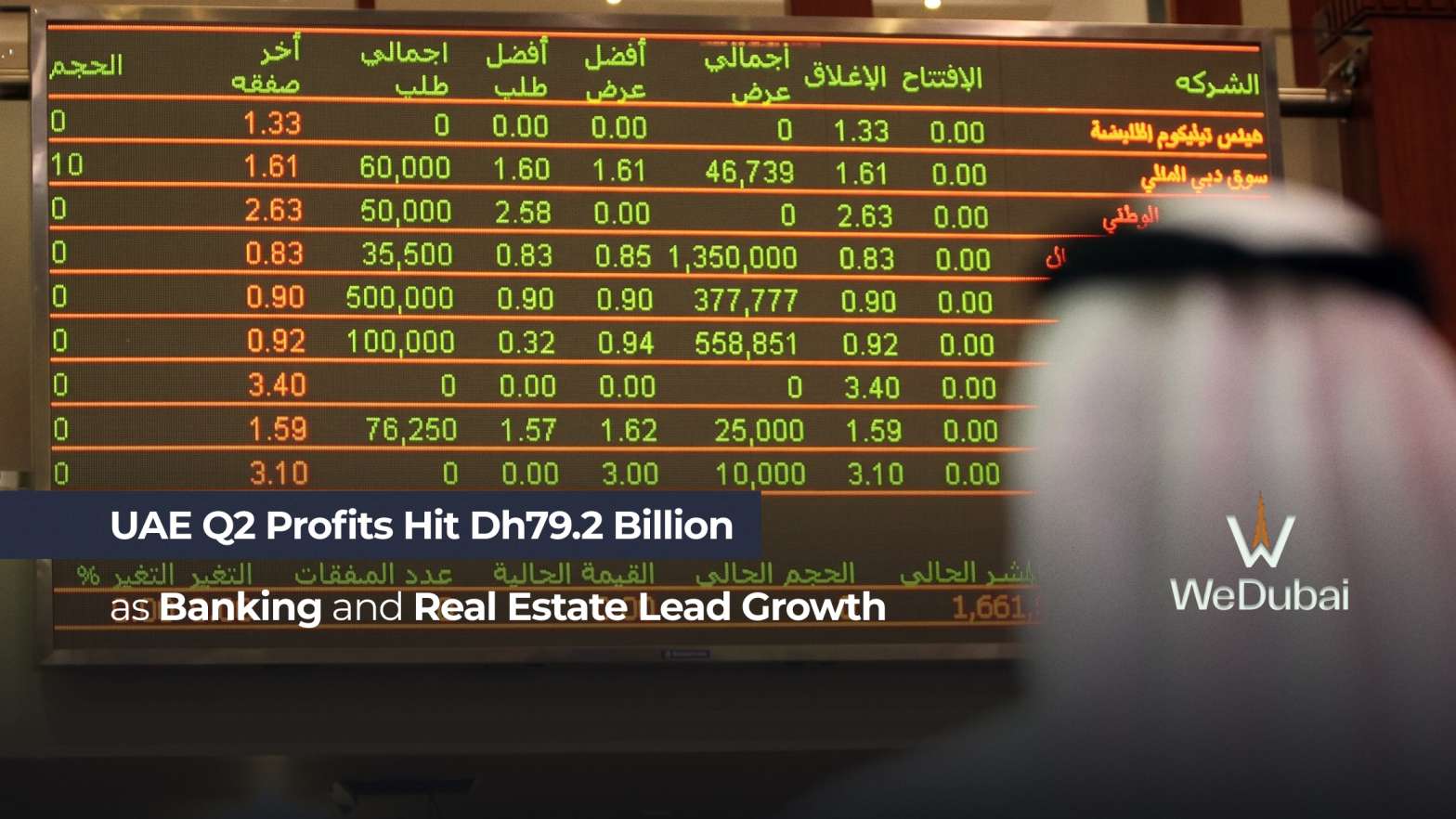
The UAE’s corporate sector delivered another strong performance in the second quarter of 2026, with listed companies in Abu Dhabi and Dubai recording combined net profits of Dh79.2 billion ($21.6 billion).
According to the latest GCC Corporate Earnings Report by Kamco Invest, UAE-listed companies increased their combined profits by 28.6% year-on-year, up from Dh61.7 billion in Q2 2025. The results highlight the resilience of the UAE economy and reinforce the strength of two sectors that continue to play a central role in the country’s growth: banking and real estate.
For investors, the numbers are particularly significant. Strong banking earnings point to continued economic and lending activity, while rising real estate profits show that demand for property remains strong across the UAE.
Abu Dhabi Drives the Biggest Share of Growth
Abu Dhabi-listed companies were responsible for much of the increase in UAE corporate profits during the quarter.
Companies listed on the Abu Dhabi Securities Exchange generated $14.7 billion (around Dh54 billion) in net profits during Q2 2026, representing a 41.8% increase compared with the same period last year.
By comparison, companies listed on the Dubai Financial Market recorded approximately $6.9 billion (Dh25.3 billion) in quarterly net profits, an increase of 4.9% year-on-year.
The difference between the two markets is important. Abu Dhabi delivered the stronger percentage growth, while Dubai continued to produce solid results across several major sectors, particularly banking and real estate.
Looking at the first half of the year, the combined picture becomes even stronger. UAE-listed companies generated approximately $38.9 billion in net profits during H1 2026, up 21.6% from $32 billion during the first half of 2025.
Abu Dhabi accounted for $25.2 billion of that total, while Dubai-listed companies generated $13.7 billion.
Banking Remains a Major Growth Engine
Banking continues to be one of the strongest pillars of the UAE economy.
In Abu Dhabi, listed banks generated approximately $3.5 billion in Q2 earnings, an increase of 12.1% compared with the same period in 2025.
First Abu Dhabi Bank remained the largest contributor, recording quarterly net profit of approximately $1.6 billion, while Abu Dhabi Commercial Bank reported profit of around $919.1 million, supported by a 12% increase in operating income.
Individual bank results also show the strength of the sector. First Abu Dhabi Bank reported Q2 2026 profit before tax of Dh7.08 billion, up 6% year-on-year, while operating income increased 7% during the first half of the year.
Dubai’s banking sector also performed well. Listed banks in the emirate recorded combined quarterly profits of approximately $3.3 billion, up 5.1% year-on-year.
The results from banks such as Emirates NBD and Mashreq helped support the sector, with Emirates NBD reporting a particularly strong first half following the consolidation of India’s RBL Bank.
For the wider economy, strong bank earnings are important because they reflect continued business activity, financing demand and financial-sector stability.
Real Estate Is Back in the Spotlight
For Dubai property investors, perhaps the most important part of the latest earnings data is the performance of the real estate sector.
Dubai’s listed real estate companies recorded 20.1% growth in net profits, reaching approximately $1.9 billion during the quarter.
That performance was led by major developers, including Emaar Properties.
Emaar Properties reported approximately $1 billion in quarterly net profit, supported by property sales of around $7.2 billion.
The company also ended the period with a substantial property sales backlog of approximately $44.9 billion, highlighting the volume of future revenue already supported by contracted sales.
Emaar Development also remained a major contributor, reporting approximately $1.5 billion in first-half earnings.
The significance goes beyond the performance of individual developers.
In Dubai, banking and real estate together represented 75.9% of total quarterly profits among listed companies, making the two sectors central to the emirate’s corporate earnings story.
What Does This Mean for Dubai Property Investors?
The latest corporate earnings provide another indication that Dubai’s real estate market is operating within a broader environment of strong economic activity.
For property investors, developer profitability matters because it can reflect several underlying trends: strong sales volumes, continued buyer demand, large development pipelines and confidence in future market conditions.
The Emaar results are a useful example.
Strong property sales combined with a large backlog indicate that demand is not limited to completed homes. Buyers are continuing to commit capital to new projects, giving major developers visibility over future revenues.
This is particularly relevant to Dubai’s off-plan market, which remains a major component of the emirate’s residential sector.
At the same time, investors should not interpret strong corporate earnings as a guarantee that every property or every Dubai community will perform equally well.
Location, developer reputation, entry price, rental demand, supply levels and the specific characteristics of a project remain critical when evaluating an investment.
UAE Corporate Strength Is Supporting Investor Confidence
The latest earnings data also arrive against a backdrop of continued economic activity across the UAE.
Recent business data has shown strong momentum in the country’s non-oil private sector. In August, the UAE Purchasing Managers’ Index rose to 55.3, its highest level since December 2024, supported by stronger output and new business growth.
This combination of corporate profitability and private-sector expansion helps explain why investor interest in the UAE remains strong.
Dubai and Abu Dhabi have continued to attract international capital across real estate, financial services, technology, infrastructure and other sectors.
For international investors considering Dubai property, this broader economic picture matters.
Real estate does not operate in isolation. A strong banking system, growing businesses, rising corporate earnings and continued investment can all contribute to employment, population growth, housing demand and overall economic activity.
Dubai Continues to Stand Out
Dubai’s Q2 results are especially interesting because the emirate’s economy has become increasingly diversified.
While real estate remains a major contributor, Dubai’s listed companies span banking, telecommunications, utilities, transportation, industrials, consumer businesses and other sectors.
Nine of Dubai’s 13 listed sectors recorded year-on-year profit growth during Q2, according to the Kamco Invest data.
That diversification is important for investors.
A property market supported by a broad economy can benefit from demand generated by different groups — entrepreneurs, corporate employees, international businesses, high-net-worth individuals, professionals and overseas investors.
This helps create multiple sources of demand rather than relying on a single industry.
A Stronger Corporate Picture for the UAE
The UAE’s performance also compares positively with the wider GCC.
Across GCC exchanges, listed companies generated approximately $74.8 billion in net profits during Q2 2026, representing a 31.3% year-on-year increase and marking another record for the region.
The UAE therefore remains an important contributor to the broader Gulf corporate earnings story.
Higher energy prices played a role in regional results, but the UAE’s performance also reflects the strength of its banking, real estate and diversified business sectors.
That combination is particularly important for Dubai, where international investors are increasingly looking beyond property prices alone and assessing the wider economic environment supporting their investment.
What Investors Should Watch Next
The Q2 earnings numbers provide a positive snapshot, but investors should continue monitoring several factors through the remainder of 2026.
These include property transaction volumes, new residential supply, rental growth, mortgage conditions, interest rates, developer sales and corporate earnings.
The relationship between supply and demand will remain particularly important for Dubai real estate.
Strong demand can support prices and rents, but large amounts of new supply entering the market can create different conditions between communities and property types.
Investors should therefore focus on individual opportunities rather than treating Dubai as one single market.
The Bigger Picture
The UAE’s Dh79.2 billion in Q2 corporate profits is more than a headline number.
It reflects the strength of some of the country’s most important economic sectors, with banking providing a strong financial foundation and real estate continuing to generate significant corporate earnings.
For Dubai property investors, the 20.1% increase in real estate profits is particularly notable. Major developers are reporting strong sales, significant earnings and substantial future revenue backlogs.
Combined with continued banking-sector growth and broader private-sector expansion, the latest results reinforce Dubai’s position as one of the region’s most active investment markets.
The numbers do not eliminate investment risk, and they do not mean every property will deliver strong returns. But they do provide another important signal: Dubai’s real estate market continues to operate within a broader economy capable of generating strong corporate growth.
For investors looking at Dubai property in 2026, that wider economic strength is becoming just as important as the property itself.