
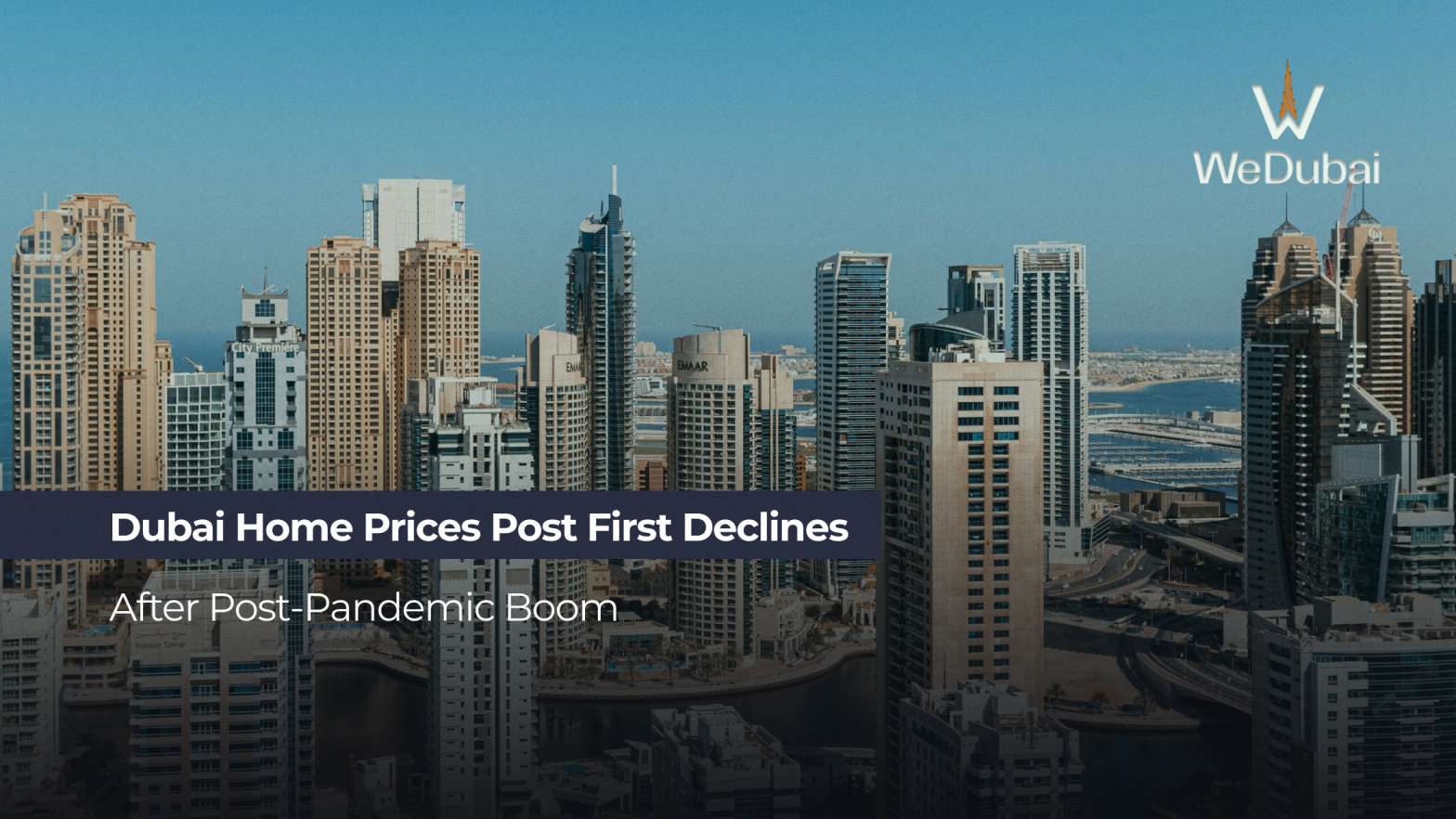
Dubai's residential market has spent five months going down. The headline is easy to write and easy to misread, so it is worth setting out what the numbers actually say before drawing any conclusion from them.
Capital values across the emirate have adjusted by roughly 10% since late February 2026, when regional conflict broke out and sentiment turned. That is the real number, and there is no useful way to soften it. But the shape of that decline matters more than its total, and the shape has changed considerably.
The correction is decelerating, month by month
The ValuStrat Price Index — which tracks residential capital values across more than 70 Dubai communities and is used as a benchmark by several UAE banks — tells a clear story when you read it in sequence rather than in headlines:
MonthMonthly changeMarch 2026−5.9%April 2026−1.9%May 2026−1.2%June 2026−1.0%
The index closed June at 220 points, against a January 2021 base of 100. The first month absorbed most of the shock. Every month since has absorbed progressively less.
Year-on-year, the market is close to flat: annual growth sits at roughly 0.1%. Put plainly, prices today are approximately where they were twelve months ago, after a four-year run in which they rose more than 70%.
Villas and apartments have moved differently
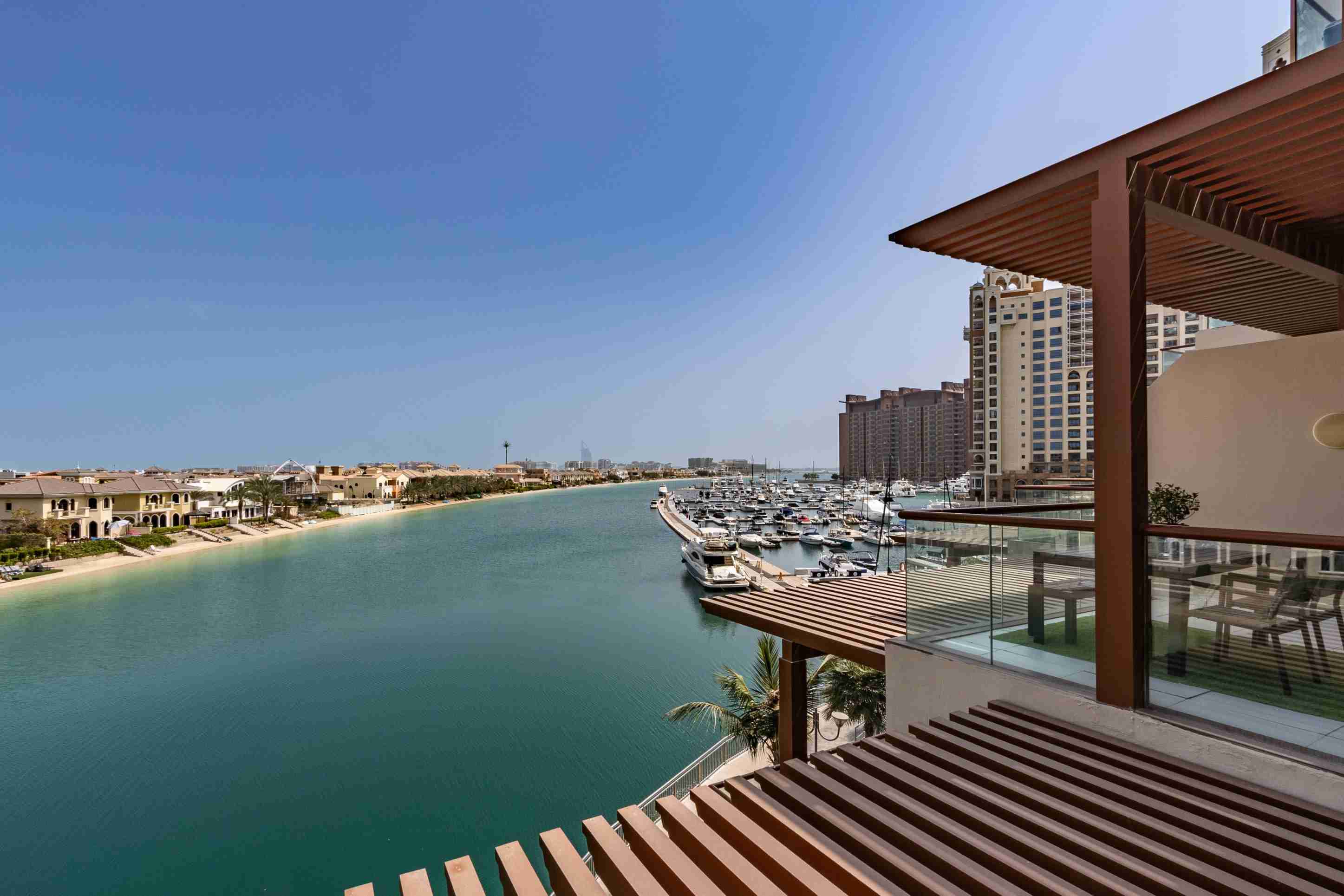
Villas closed June at 293.7 index points — down around 1.2% on the month, but still up roughly 2% year-on-year. Apartments closed at 169.1 points, down about 0.6% on the month and around 3% down annually.
That gap is worth noting. The villa segment, which led the entire post-2020 cycle, has given back less. The apartment segment, which had more speculative money in it, has given back more.
Buyers came back before the prices stopped falling
This is the part the headlines have largely missed.
Transactions for ready homes rose 46.8% month-on-month in June — the strongest single monthly expansion in three years. That is not a market in retreat. That is a market where a price adjustment did exactly what price adjustments are supposed to do: bring buyers who had been waiting on the sidelines back to the table.
Dubai recorded roughly AED 286 billion in property sales across the first half of 2026. The composition of that activity has shifted, though:
Ready property transactions clustered in Jumeirah Village Circle, Jebel Ali Village and Business Bay.
Off-plan activity concentrated heavily in Azizi Venice, with City of Arabia and Dubailand Residence Complex following.
Affordable stock matters more than it used to. Sector data suggests homes priced under AED 1 million now account for somewhere between 30% and 40% of transactions.
The luxury end barely moved
While the mainstream market repriced, the top of the market carried on largely as before. June saw 19 ready-property transactions above AED 30 million, five of them above AED 50 million.
Those deals remained tightly concentrated in the same handful of addresses that have always absorbed this kind of capital: Palm Jumeirah, Emirates Hills, Dubai Hills Estate, Al Barari, Jumeirah Islands, Downtown Dubai and DIFC.
This is a familiar pattern in prime markets worldwide. Buyers at that level are rarely leveraged, rarely in a hurry and rarely trading on twelve-month price movements. Scarcity of genuinely irreplaceable addresses does more work than sentiment does.
That said, prime was not immune during the sharpest month. In March, Palm Jumeirah recorded a monthly decline of around 8.4%, and villa communities including Arabian Ranches Phase 2 and Dubai Hills Estate fell more than 10% in that single month.
Prime held its annual position better than most — it did not sit out the correction entirely.
Dispersion is now the story, not direction
Citywide averages have become a poor guide to what is happening in any specific community. On a twelve-month view, the spread is wide:
Villa communities up annually: Jumeirah Islands (approx. +17.9%), Emirates Hills (+10.7%), The Meadows (+10%), The Villa (+7.8%), Reem (+5.7%).
Villa communities down annually: Mudon (−5%), Victory Heights (−4%), International City (−3.2%), Dubai Hills Estate (−2.8%).
Two communities in the same emirate, in the same twelve months, more than twenty percentage points apart.
Anyone quoting you a single Dubai-wide figure is not telling you anything actionable about the specific building you are considering.
What is driving it?
The trigger was geopolitical, not structural.
The turn dates precisely to the outbreak of regional conflict in late February. This was not an oversupply crisis of the 2009 or 2014 kind, where the market ran out of buyers. Demand paused; it did not disappear — which is precisely why it returned as quickly as it did once conditions steadied.
Supply is nonetheless a genuine factor.
Roughly 120,000 new homes are scheduled for handover across Dubai during 2026. Volume of that scale puts real pressure on the mid-market and on rents, and it will keep doing so regardless of sentiment.
The buyer base has changed.
The current cycle is driven far more by long-term owner-occupiers — people buying around schools, family plans and golden visa eligibility — than by short-hold speculators. Owner-occupiers do not panic-sell into a soft month. That behaviour puts a meaningful floor under prices.
External assessment supports the moderate reading.
Following its UAE staff visit concluded on 16 July 2026, the IMF characterised real estate activity in the first half of the year as having moderated, with prices broadly remaining at or above 2025 levels.
And regionally, capital moved rather than left.
Abu Dhabi transactions rose sharply over the same half-year period, reaching roughly AED 117 billion — a rise of around 112%. Money did not exit the UAE. Some of it changed emirate.
What this means if you are buying?
Negotiating room exists now that did not exist in 2025. The market has shifted from seller's to broadly balanced. Asking prices are more likely to be tested, and developers are competing on payment terms.
Rents are softening too. This matters if you are buying for yield. Run your numbers on current achievable rent, not on the rent the unit commanded eighteen months ago.
Community selection is doing most of the work. Given the dispersion above, the choice of building matters considerably more right now than the choice of timing.
Service charges deserve more scrutiny than usual. In a flat-price year, the difference between AED 12 and AED 25 per square foot in annual charges is the difference between a decent net yield and a mediocre one.
What this means if you already own?
If you bought before 2024, you remain comfortably ahead. A 10% adjustment against a cycle that delivered more than 70% is a modest give-back.
If you bought in 2025, you may be roughly flat — annual growth citywide sits near zero. That is uncomfortable but not distressed, and the deceleration in monthly declines suggests the worst of the adjustment is behind rather than ahead.
Selling into the current market means accepting the correction. Holding means waiting out a market that, by transaction volume, is already recovering.
The Honest Summary
Dubai had a four-year run that could not continue at that pace indefinitely. A geopolitical shock ended it. Prices corrected around 10%, most of that in a single month, and the correction has been slowing steadily ever since while buyers have returned in volume.
That is neither a boom nor a crash. It is a market finding a level — and, for buyers who spent the last two years priced out or outbid, it is a considerably more workable one than the market of twelve months ago.
Connect with us before you act on a headline!
Citywide averages will not tell you what your building is worth. We track transaction-level data across Dubai's freehold communities and can tell you what has actually happened to prices in the specific development you are considering.